"If I can put this in context for you," [said RCMP assistant commissioner Mike McDonell.] "The 1995 bombing of the Murrah Federal Building in Oklahoma City that killed 168 people was completed with only one tonne of ammonium nitrate."Check it out.
Sunday, June 04, 2006
Oh, Canada!
Excellent post by James over at the Chicago Boyz blog, about the recent arrest of 17 suspected terrorists in Canada. These guys had amassed 3 tons of ammonium nitrate; according to a Toronto Star article quoted by James:
Not just for Cheese Anymore
I remember James telling me about an television ad created by the National Cheese Council (we're very big on food product councils here in the US). It showed a picture of the moon, and said something like: "in 1969, man went to the moon and discovered it was not made of cheese." [pause] "We haven't been back since." I remember seeing it. It depressed James, he said -- he remembered, as a kid, watching the first moon landing and keeping fascinated track of the landings until they ended in 1972, and like many people wishes he could go up there. Like many people, too, I think he was hoping that by this year, there'd be commercial flights to the moon, and it's depressing to think that we haven't even been able to go up there vicariously through someone else, since no one's gone.
Well, check out this news item from Yahoo News: Yes! The article talks about a lot of new technology that will have to be developed. One of the things that has always blown my mind is the level of tech we had when we went there in the first place - someone told me that the computers were the equivalent of a TRS-80. My Dad had one of those in the office. He decided not to spend the extra expense for the floppy-disk drive and had a tape (as in, "cassette") drive. To save data, you had to press "play" and "record" at the same time. Yes. Really. I remember the scenes in "Apollo 13", where the scientists on the ground are furiously working their slide rules in order to recalculate information for the astronauts in trouble up in space. Slide rules. And it worked.
Bob Park, a scientist who writes a really good (and very scathing) weekly summary of science-related news, doesn't like the idea of manned missions to Mars and I gather he probably won't like this one either. He does have a point in that it's far more cost-effective, and safer, to send robots. But I still think there should be people going, as much as that adds to the already incredible expense: 1) because I think that we should, as a species, leave the solar system and explore (I'm a hopeless Star Trek fan) and 2) because often there's a great benefit by having a human there. We're capable of an intuitive type of inspiration that I think could make for some amazing discoveries if not limited by the narrow field-of-view and range of a robot. We just need to go there and look around. Perhaps I'm hopeless.
I think we'll make it there in about 2022, adjusting for the usual governmental bloat & delay. If we were in a race with another country, we could do it in 2015. (Hello, China, wanna race?)
Anyway: to you folks, of whatever nationality, who'll spring off of the ISS and go to the moon: excelsior!
Well, check out this news item from Yahoo News:
NASA's outlook for the future calls for humans to dig in their heels on the Moon as early as 2015 and no later than 2020.
Yes! The article talks about a lot of new technology that will have to be developed. One of the things that has always blown my mind is the level of tech we had when we went there in the first place - someone told me that the computers were the equivalent of a TRS-80. My Dad had one of those in the office. He decided not to spend the extra expense for the floppy-disk drive and had a tape (as in, "cassette") drive. To save data, you had to press "play" and "record" at the same time. Yes. Really. I remember the scenes in "Apollo 13", where the scientists on the ground are furiously working their slide rules in order to recalculate information for the astronauts in trouble up in space. Slide rules. And it worked.Bob Park, a scientist who writes a really good (and very scathing) weekly summary of science-related news, doesn't like the idea of manned missions to Mars and I gather he probably won't like this one either. He does have a point in that it's far more cost-effective, and safer, to send robots. But I still think there should be people going, as much as that adds to the already incredible expense: 1) because I think that we should, as a species, leave the solar system and explore (I'm a hopeless Star Trek fan) and 2) because often there's a great benefit by having a human there. We're capable of an intuitive type of inspiration that I think could make for some amazing discoveries if not limited by the narrow field-of-view and range of a robot. We just need to go there and look around. Perhaps I'm hopeless.
I think we'll make it there in about 2022, adjusting for the usual governmental bloat & delay. If we were in a race with another country, we could do it in 2015. (Hello, China, wanna race?)
Anyway: to you folks, of whatever nationality, who'll spring off of the ISS and go to the moon: excelsior!
Monday, May 29, 2006
Memorial Day
Today is Memorial Day in the US. I wanted to take the time to write a little about a memorial I attended last Friday.
I'm in a new Navy school now and the schoolhouse is part of the Navy's "Submarine Learning Facility". So we, as students, were required to go to a WWII submarine memorial ceremony. There was much whining and moaning about it. But not from me.
There were a lot of veterans there. I sat next to a very nice retired gentleman who was posted in the USS Skate, being honored that day by being inducted into the Norfolk Submarine Hall of Fame. The Skate was the first US nuclear submarine powered by what was going to be the "submarine fleet reactor" and, like all SSNs during the Cold War era, did some really scary things. She was the first US submarine to actually come up through the ice in the Arctic, both in the summer and the winter. The guest speaker was an engineering officer aboard her and told us some good stories about those days.
But the part of the ceremony that I'll always remember was the roll call. It's a tradition of the US Submarine Veterans of WWII to have a roll call of all of the submarines lost in WWII (and the Thresher and Scorpion) read out. Two active duty submariners read the roll: one said the name, and the other read out its disposition. "All hands lost." "All hands lost." "All hands lost." Over and over and over. With each disposition, another sailor rang a bell, and two of the wives of the veterans took a model submarine out of an array of them displayed on a table, until there were no more.
Click on any of the links below to see a picture of the ship and to read more info.
You can also read about the USS Thresher or the USS Scorpion; I highly recommend John P. Craven's "The Silent War: The Cold War Battle Beneath the Sea ", which has a riveting account of the attempt to find the Scorpion and determine what had happened to her.
But I digress. The most profound moment came after this roll, when the speakers started talking about rememberance. It was very important to them, urgent even.
It suddenly struck me: what if there's no afterlife? I mean, it's all a matter of faith, isn't it? There's no proof, just (at best) anecdotes. What if, when you die, you just die, and there's nothing more? And the memorial became all that more deep and critical: all those men, "on eternal patrol", and all the other ones who made it back and passed away after -- this memorial was their eternity.
So if you get roped into going to one of these things, don't grumble or moan. Listen. Pay attention. Understand the stories being told. If any name is said, whisper it back. Like it says on the veterans' website: "a man is not dead until he is forgotten."
I'm in a new Navy school now and the schoolhouse is part of the Navy's "Submarine Learning Facility". So we, as students, were required to go to a WWII submarine memorial ceremony. There was much whining and moaning about it. But not from me.
There were a lot of veterans there. I sat next to a very nice retired gentleman who was posted in the USS Skate, being honored that day by being inducted into the Norfolk Submarine Hall of Fame. The Skate was the first US nuclear submarine powered by what was going to be the "submarine fleet reactor" and, like all SSNs during the Cold War era, did some really scary things. She was the first US submarine to actually come up through the ice in the Arctic, both in the summer and the winter. The guest speaker was an engineering officer aboard her and told us some good stories about those days.
But the part of the ceremony that I'll always remember was the roll call. It's a tradition of the US Submarine Veterans of WWII to have a roll call of all of the submarines lost in WWII (and the Thresher and Scorpion) read out. Two active duty submariners read the roll: one said the name, and the other read out its disposition. "All hands lost." "All hands lost." "All hands lost." Over and over and over. With each disposition, another sailor rang a bell, and two of the wives of the veterans took a model submarine out of an array of them displayed on a table, until there were no more.
Click on any of the links below to see a picture of the ship and to read more info.
You can also read about the USS Thresher or the USS Scorpion; I highly recommend John P. Craven's "The Silent War: The Cold War Battle Beneath the Sea ", which has a riveting account of the attempt to find the Scorpion and determine what had happened to her.
But I digress. The most profound moment came after this roll, when the speakers started talking about rememberance. It was very important to them, urgent even.
It suddenly struck me: what if there's no afterlife? I mean, it's all a matter of faith, isn't it? There's no proof, just (at best) anecdotes. What if, when you die, you just die, and there's nothing more? And the memorial became all that more deep and critical: all those men, "on eternal patrol", and all the other ones who made it back and passed away after -- this memorial was their eternity.
So if you get roped into going to one of these things, don't grumble or moan. Listen. Pay attention. Understand the stories being told. If any name is said, whisper it back. Like it says on the veterans' website: "a man is not dead until he is forgotten."
Tuesday, March 29, 2005
Brad Has Some Good Points
I was going to post this in the comments section, but then it, well, got too long. If you haven't seen the comments that my friend Brad Hoehne left, you should check them out. My response:
[ Brad writes: ] I've just finished scanning the BBC website's coverage of this tragedy, and can't find anything that would merit a sarcastic jab. It seems pretty neutral to me.Oh, the BBC story wasn't what I was jabbing at at all (by being sarcastic). I thought it was a pretty level delivery of news. I suppose I was just foreseeing a knee-jerk anti-gun reaction to the news that this kid had gotten the firearm from his (cop) grandfather when I said "I guess that means that cops shouldn't have handguns."
It is a debatable point whether or not guns lead to increased or more deadly violence in our culture- and perhaps there's a taint of that that in the overall coverage (I'm uncertain, but the fact that Candada has more guns per capita and less gun deaths would imply that it is not guns, but something else, that is at the heart of the problem.)I agree with you. I think that it is too simplistic to say that having a large number of guns automatically means having more violence, and that having fewer guns automatically means less violence. I believe that cultural values have a LOT to do with it: look at Switzerland, which high levels of gun ownership and low levels of crime, and look at Japan, with low levels of gun ownership and low levels of crime. Or Britain, with low levels of gun ownership and high levels of crime. There is much, much, much more going on here than a simple guns = violence equation.
I think it's even more difficult, in the US, to talk about culture and cultural values, because we aren't just one culture. This isn't going to come out very well, I warn you in advance -- the best I can do is refer you to Neal Stephenson's "Diamond Age", in which he talks about culture as "shared set of values", which doesn't necessarily have to do with racial or ethnic or historical backgrounds. It's a much broader interpretation of the term "culture" than we usually use. In "Diamond Age", world governments have fractured into franchised "countries", and there are several very powerful political entities known as "phyles" which are based on shared values (and sometimes, but not necessarily) there's an ethnic component. For example, "New Atlantis" is a tech-savvy group which takes its values (and fashion sense, and decor, etc) from Victorian-era England.
The reason why I bring this up is because I -- woefully uneducated in social sciences, mind you, so I am no kind of expert -- could easily point to several different "cultures" in the US who have different definitions of "success", both personal and cultural, and acceptance of the means to same, and opinions regarding the use of violence and the need for laws. There is an inner-city culture, not limited to race or gender, that values the acclimation of stuff ("bling") above all else. You are not successful unless you have snow-white shoes, a fabulously expensive car, and enough gold to ruin an economy hanging around your neck, as well as a large group of hangers-on. And it's perfectly okay to steal, sell drugs, or otherwise break the law to be successful, as long as you're not caught (and even if you're caught, that too is a status symbol). Violence is acceptable, because it shows you're a tough badass, and everyone NEEDS to know what an absolute badass you are. There is the culture of my parents, which is middle-class college-professor-type culture, which holds that personal success is very important, but that it isn't necessarily tied to having a large amount of stuff and/or money (although that certainly would be nice); breaking the law is not acceptable here (the rule is: be successful within the framework), and it would RUIN one's career to be caught breaking the law. Adherence to violence or value of material goods isn't related to the amount of money you have, either; there are several "cultures" (to use the word loosely) which values earning your own way, within the law, no matter what (the first thing that springs to mind are certain hardscrabble Appalacian cultures who are poor, but self-reliant and proud).
Anyway, my ultimate point is this: violence against persons, and the willingness to commit same, is a factor of cultural, personal, and family values towards these questions
- how much does that culture, person, and/or family value the life of another human being?
- What is the relative worth of that value as compared to the value of success?
For what it's worth (not that you suggested this, 'cause you didn't), but I'm not sure it's useful to use a case such as the Red Lake case to determine widespread firearms policy (it just seems that a clarion call goes up every time something like this happens, and I agree with you: it seems odd, though I am thankful for that, that it doesn't happen more). Anyway, as the news stories come out, it becomes much more evident how very troubled this young man was, and the rather extraordinary circumstances he was in. Not completely uncommon, but unusual: it would not be beneficial, I think, to create policy regarding guns around him. I recall reading a news article (sadly, I don't remember where) about other cases where similar rampages were planned, but stopped, because students knew about it and spoke up. The point of the article was that in every single incident like Columbine and Red Lake, someone -- usually multiple someones -- knew that it was going to happen, and didn't speak up for various reasons: fear of being "a snitch", or fear of getting too involved in a student's home life, for example. The article supports what many teachers in the articles suggested: that it is more important to change the school's cultural values that discourage people from speaking up and getting involved than it is to come up with more bandaid measures such as banning guns. Treat the cause, they say, not the symptom, and I think that's a good idea.
My take is that well known movies describing similar events (like "if..." or "The Basketball Diaries") didn't evince a similar response because they weren't real. A real event, taken seriously by the media, and drilled into kids heads by our culture, has far more import.I think that this is a very interesting, and very good point. These events are real, are taken very seriously, and get an incredible amount of attention. Just the panacea for a kid who can't get the attention he feels he deserves otherwise.
Tuesday, March 22, 2005
Whoa!
Whoa! It's been more than a month! Ach, I can hear the crickets...cricketing. But I just had to post a comment, a thought, regarding a BBC article about the Red Lake school shooting:
Weise first used a .22-calibre weapon to kill his grandfather, veteran police sergeant Daryl Lussier and his companion Michelle Sigana, at their home on the Red Lake Indian Reservation, FBI special agent Michael Tadman told reporters.I guess that means that cops shouldn't have handguns. <-- this is sarcastic! I really am (and this is not sarcastic) sad that those children were killed, and I am sad that neither I nor James were there. I've been going through Anti-terrorism/Force-protection ("AT/FP") training on the ship, and it makes me wonder if we need to start some kind of program for the school. Or maybe someone needs to stand watch. I would.He then stole his grandfather's police gunbelt and bullet-proof vest, and at least another two weapons - a handgun and a shotgun - before driving to the school in his grandfather's police car.
Sunday, February 06, 2005
More Excuses For Not Blogging
Looks like I won't be regularly blogging for a while -- I'm moving, see, and I have to pack up all my stuff.
Ever notice how you figure, "I should be okay with x boxes", and then it turns out you need at least 2x boxes?
I bought a shredder. That might help. So far, the clothes boxes outnumber the book boxes, but I figure that's only because clothes tend to be more bulky than books.
Anyway, James linked to a neat website yesterday, The Oops List, and I noticed that they had some pictures of the USS San Francisco. That's the sub that ran into an underwater mountain going at about 40 knots recently.
Pic 1
Pic 2
That is some impressive damage. KUAM 8 News had a nice article about MM2(SW) Joseph Allen Ashley, who died due to head injuries.
In unrelated news, we got our new cammies and will start wearing them tomorrow. Gotta go shine my new boots now.
A pity I couldn't wear 'em last week -- we went into the sonar dome on the McFaul to x-ray it, and it would have been a GREAT stress-test of the new uniforms to wear them. It's very wet and dirty down there. I'll have pictures as soon as I can find the computer cabling for my camera.
Ever notice how you figure, "I should be okay with x boxes", and then it turns out you need at least 2x boxes?
I bought a shredder. That might help. So far, the clothes boxes outnumber the book boxes, but I figure that's only because clothes tend to be more bulky than books.
Anyway, James linked to a neat website yesterday, The Oops List, and I noticed that they had some pictures of the USS San Francisco. That's the sub that ran into an underwater mountain going at about 40 knots recently.
Pic 1
Pic 2
That is some impressive damage. KUAM 8 News had a nice article about MM2(SW) Joseph Allen Ashley, who died due to head injuries.
In unrelated news, we got our new cammies and will start wearing them tomorrow. Gotta go shine my new boots now.
A pity I couldn't wear 'em last week -- we went into the sonar dome on the McFaul to x-ray it, and it would have been a GREAT stress-test of the new uniforms to wear them. It's very wet and dirty down there. I'll have pictures as soon as I can find the computer cabling for my camera.
Sunday, January 30, 2005
Why Not Be Creative When You Go?
 From the BBC, a picture-album article about a craftsman in Accra, Ghana, who makes some very interesting custom coffins for people. This guy should get in with Novica, he'd make some decent money selling to an international market. If you wanted to find someone doing custom coffins stateside, you could go with Outhouse Charlie -- alas, his website isn't up yet, so there are no examples of his work. Bet you he could make you some mad crazy wooden or fiberglass coffins, though...
Saturday, January 08, 2005
@#$@^% AWESOME!
Okay, okay. So I'm drunk on two-water--well, one-water--grog. I admit it. But Firefly is AWESOME. I remember, while reading critical reviews of science-fiction, about the relationship between westerns and science-fictions. In particular, Star Trek was supposed to be some great Space Western. Well, the folks who did Firefly really took the whole western theme to heart. Firefly IS a space western, with the guns and the accents and the music and EVERYTHING, mixed in with great humor. And oh, how I weep that it was on Fox, the people who never advertise anything decent (Millenium and Space Above and Beyond springing to mind) and then cancelling it after a small number of episodes if the bloody advertiser response is not great enough, damn their soullless hearts. 'Cause I went and bought Firefly and have just watched the first episode and MY GOD, it's WONDERFUL. Go thou forth and buy it, it's incredible!
"Hathcock". "Hancock". Coincidence?
Blackfive, from whose blog I got the information about the teddy bear drive, also has a link to an article about a Marine Corps sniper who took out an insurgent from 1,050 yards away. Magic most grim & deadly.
Cookies
The Bonhomme Richard is hard at work.
In support of Operation Unified Assistance, multipurpose amphibious assault ship USS Bonhomme Richard (BHR) (LHD 6) delivered more than 7,000 pounds of humanitarian assistance Jan. 7 to disaster stricken areas of Sumatra, including Banda Aceh and Blagpidie.There's a nice picture at the site of U.S. Marines helping to pack huge crates of MREs (Meals Ready to Eat) for the victims of the tsunamis. My favorite part of the article is this:
To uplift the spirits of the local population in the hard hit Banda Aceh area, BHR’s culinary specialists worked around the clock Jan. 6, with all ovens full speed ahead, to bake more than 22,400 cookies for the people around northern Sumatra.This is awesome -- not only are the Navy recipes for cookies really good (I have gained 10 pounds since being onboard, alas), but there's just something special about cookies. When we're at sea, the ship often has to refuel and take on supplies. On deployment, that's every three days or so, usually, depending on what's going on. It's traditional for the ships to swap stuff, usually by tying it in a plastic bag to one of the fuel hoses: some ship's hats or coins (coins are very popular), photos, that sort of thing. We usually made up a huge box of cookies, which we'd triple-wrap in plastic and send back to the ship as a thank-you. Reading about the Bonhomme Richard's cookies made me remember this. "Let them eat cake, huh?" Detractors might scoff, but I think instead that it's more like hugging someone you can't reach. The military can seem cold and distant, but it's these sorts of things -- the cookies, or the teddy bears that Gunny Sergeant Mike got together to send to the children of Iraq -- that remind you that the military is a group of human beings who, minus the occassional person who doesn't care about anything, really do care about the people they're helping or defending.
If Only It Could Really Do This
 I'm sure you've already seen this, all you hip people who regularly browse the sites devoted to cool commercials or who are on the cc: lists of all of the well-connected people at work. I don't look around as much as I should, and not too many of the people I work with forward me much of anything (except uncool things like watchbills), so I ran into this for the first time quite recently. If you haven't seen it, check it out -- it is really neat. Richard Eriksson talks about it and has links to an article about how the video was made, as well as a link to the effects studio that made it, The Embassy. It doesn't look like they've made much, but this one is a real standout. I love the little details, such as the sidepanels shifting as the arms move and the fact that the animation is carried through a shaky man-on-the-scene cut in between the steadycam and static camera cuts. It makes me happy. Enjoy!
Who Benefits?
Ah, modern America. I'm waiting for an oil change at Hall Honda and they've installed Web access in the waiting lobby. I love these guys.
Anyway, I wanted to comment about the new (and inevitable) reporting about the possibilities of the US either causing, or failing to forewarn countries about, the tsunami. James links to some good articles about the whole brouhaha.
First off, I checked out the link on Natalie Solent's article on the "biased BBC" website. It's a BBC article, and say what you will about the BBC, but I think it's cool they allow for the readership to post comments (whether they actually read, think about, or heed those comments is another question). I was disgusted by the article, but heartened by the comments, most of which were along the lines of "this is bull*$#$", pointing out such matters as the fact that the US might, just possibly, do environmental and oceanographic surveys before placing an extremely expensive Naval base somewhere so as to mitigate the effects of wind & weather. It's nice to see that the majority of commentors believe that this is all nonsense. But why does the story come up? Natalie talks about scientific ignorance, and I think that's exactly it: the people who are talking up these conspiracy theories are ignorant of what modern technology is capable of -- to them, the US has this magical ability to communicate; therefore, a failure to communicate must have been intentional.
Let's work this all out: the National Oceanographic people see evidence of this massive earthquake. "Hey," they say. "Big earthquake. We should start telling people." Here's your question: how? Natalie stated it best in her article: "I'm a scientist! Get me the President of Indonesia!" So you're going to use the phone? Okay. How does the information get from NOAA to the people who need it, such as all those fishing villagers and tourists on the beach?
It's easy to get a warning to a Naval Base. Any Naval Base in the world is furry with antennae and fat from all the communications equipment. Communications is absolutely central to military activity -- hell, if something goes down, we have to know about it right away. How do you think we got aid on the way so damn fast?
But to tourists & villagers? How long does it take to get emergency information to the average citizen in the US who has everyday access to what -- for the majority of the world -- is high communications technology? How long did it take the people in the Twin Towers to find out that something was going on, and then to start evacuation? And the majority of them still weren't out by the time the towers came down, which (as I recall) was hours later.
The tsunami travelled at 500 miles per hour. How could we possibly have gotten word to all affected governments in its path in time, and even if we had, how could we (and they) have possibly gotten people out of the way in time?
Yes, the US has access to a dizzying array of technological and communication marvels. This is true. But the fact that we can't employ them doesn't mean that we have some agenda that leads us to let a quarter of a million people die. The technology has to be there on the other side for this to work.
Al, in Brazil, left this comment in the BBC article:
It IS ODD. And I don't think its anti-US sentiment but something a lot more worrying about all these conspiracy theories. What if it isn't just paranoia after all? Should we be scared? Who profits? (With anti sentiment, fear, or else?) Please do approach these questions. Thank you.Well, I think what's clear is that it's the news outlets' advertisers who profit from this sort of uncritical thinking, because sensation draws readership like an ant trap draws ants.
Wednesday, January 05, 2005
The One That Got Away
On a lighter note, I have a sea story to relate.
We pulled out of Naval Station Norfolk a while ago. This involves setting the sea & anchor detail -- people whose watches related to the sometimes tricky proposition of pulling away from a pier and getting through restricted navigational waters until we're far enough out to sea to have some "breathing room". The spots in the rivers and bays around here are marked with buoys to indicate navigation channels, and we (mostly) stay in those channels (unless we're in a nice deep bay and some other unnamed ship decides to almost run into us and we have to kick up to full speed and zoom around it, not that that recently happened or anything). I am on the sea & anchor detail -- my job: man one of the M-2HB .50 caliber machine guns we have set up to deter small boats from attacking us. In an ideal situation, we're not shooting anything; instead, we gun watchstanders act as additional lookouts, reporting close contacts up to a central monitoring point. It's a pretty long sea & anchor detail to get out of Norfolk -- about 3 hours. In nice weather, it's great. In winter, especially when it's raining, well, it sucks. But hey, it's an adventure, right?
So anyway, we got underway, and there I was, standing topside (outside) in about 15 layers of clothing. It was actually really nice outside, but the wind was still cold, so I was glad for the fabric (MOM: THANK YOU FOR THE SILK THERMAL UNDERWEAR!). We came across a gaggle of fishing boats, and most of them were outside the channel in their little boats. One, though, was either on the edge of the channel or slightly inside it. So he was fairly close to where we were going to go -- not so close as to cause us to worry about collision but, as I said to my partner at the time, "oh, man, we're gonna swamp that guy with our wake". So we steam by him, and see the reason why he's not getting out of our way: he's got a net on a pole and is trying to catch a fish he's hooked that's this big <makes classic 'fish-that-got-away' size sign with hands>. He tries for it once, misses. Tries for it again, and at this point our wake has hit his boat and sets it to rocking. He misses again and the fish is gone.
"OHHHHHH!" He throws up his hands and yells, in that classic frustrated voice. We've been watching this whole scene, too, so we throw up our hands and yell in sympathy too.
The guy thumps back on his back in his boat, slapping his hands to his face, then gets up and yells, "HE GOT MY LURE!" I do the Italian hand-waving thing and yell "OH NO!" in sympathy -- my partner busts out laughing. So I turned to him and said, "Dude!" But the guy on the boat was laughing too, and we all waved at each other as the McFaul pulled away.
People used to wave at us when we sailed on by, I'm told. I don't see it that often; it makes for a rather chilly feeling when coming or going. I wonder what people think, when they just watch as we go by: are they worried we'll shoot them? Do they think we're all baby killers? Are they just hung over and not in the mood? I don't know. But that was a really cool moment (except that it was a shame that the guy lost the fish -- it really was this big). It's nice to make a connection with the folks we're serving out to sea, out to sea.
Half-Masted Flags
Ever since the tsunami disaster, all the ships at Norfolk Naval Base (and the base) have half-masted their flags. It's a way to show respect for those who have died, and to indicate that the service is in mourning for their loss We went to another installation, one with a crane, and they'd rigged their flag to hang from the crane hoist with a weight on the end to keep it stable. And they'd lowered the flag to half-mast; too
Some cynical people (or the UN) might say that we're only mourning for the Americans (or Westerners) who died. But I know better.
Sunday, January 02, 2005
The US Navy Just Keeps Getting Stingier and Stingier...
The story's actually a couple of days old now, but I want to post about it anyway.
Twelve ships from the U.S. Navy's Military Sealift Command will support the United States' relief effort for victims of the tsunami that devastated South Asia Dec. 26.TWELVE! Check out this pic of the USNS Ranier (warning, it's very huge). See that spot sort of in the middle, where there's an opening in the railing of the ship, and there's a sort of slightly curved, darker grey thingie overhanging that opening? That's a RHIB -- a Rigid Hull Inflatable Boat. Seats 18 people in good weather. This should give you a good idea of the scale of this thing.
In addition, there are several articles on the above-linked website that talk about how the whole Abraham Lincoln Strike Group is being sent south to help. I'd already talked about the cost of sending the Abraham Lincoln alone; here are the other members of the STRIKEGRU:
The Lincoln Carrier Strike Group will deploy with the following San Diego-based ships: the cruiser USS Shiloh (CG 67), commanded by Capt. Joe Harriss; and the destroyer USS Benfold (DDG 65), commanded by Cmdr. Don Hornbeck. Other ships deploying with the Lincoln Carrier Strike Group include the Everett, Wash.-based destroyer USS Shoup (DDG 86), led by Cmdr. Alexander T. Casimes; the Pearl Harbor-based attack submarine USS Louisville (SSN 724), under the command of Cmdr. David Kirk; and the fast combat support ship USS Rainier (AOE 7), based in Bremerton, Wash,.This is on top of all the cash we're donating. So I don't want to hear any more lip out of the UN about us being stingy. As for "moral authority", well, my response is in keeping with most of the blogs I've read so far:
NUTS!
Gotta run -- don't want to be late for watch.
Saturday, January 01, 2005
A Merry Cthulhu Christmas
Okay, so it's six days past Christmas already. Let's just say that I failed my Spot Hidden roll.
Friday, December 31, 2004


A Chilling View
From the National Oceanic and Atmospheric Administration, whose Web page has a timeline of the NOAA's own actions in response to the warning signals it received from ocean monitoring equipment comes a chilling animation of the tsunami wave. Click on the pic below to see the full-sized QuickTime animation.
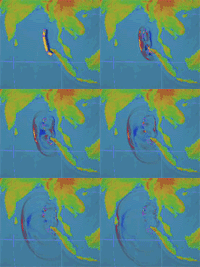
Make sure you look through the rest of the site, it's fascinating and also features a database of historical tsunami events.
Make sure you look through the rest of the site, it's fascinating and also features a database of historical tsunami events.
p-t-r wn
 I found a story at BBC News that should be interesting to anyone who likes Ancient Egypt or rabbits -- the British Museum is publishing a version of Peter Rabbit in Middle Kingdom hieroglypics:
Peter Rabbit becomes a square, a semi-circle, an ellipse and a rabbit image.The text pictured reads "Once upon a time, there were four little rabbits and their names were Flopsy, Mopsy, Cotton-tail and Peter..." The article mentions some difficulty in trying for a literal translation from English to Middle Kingdom:The "time seemed appropriate" for the hieroglyph version, due in April, translators said, as the story had already been published in 35 languages.
Potter's landscape and wildlife would also have been unfamiliar to ancient Egyptians - who had no words for things like blackberry, gooseberry, blackcurrant and potato.Don't know how to read hieroglyphs? Omniglot is a good place to start for info."Beatrix Potter's words sometimes do not readily fall into ancient Egyptian," [translators Richard Parkinson and John Nunn] wrote in the foreword.
"The surviving texts provide no easy model for such colloquial phrases as 'Now run along, and don't get into mischief.'"
Subscribe to:
Posts (Atom)